From Kennels to Pet Care Platforms

October 12, 2026 · Written by Craig Lawson, Managing Director at Hyde Park Capital
The grooming, boarding/daycare, pet sitting/walking and training subsegment of the non-medical pet services market is a large fragmented market sitting within the broader US Pet Industry (estimated 2026 expenditures of $165 billion). Estimates place the pet sitting/walking, grooming and boarding/daycare segments at $1.7B, $4.3B and $6.3B, respectively. And while the space, like much of the rest of the pet/vet industry faces some current headwinds, much of it “affordability” related, a strong opportunity exists to convert inconsistent local service businesses into scalable pet care platforms through better systems, staffing, reporting, facility-level economics, and consolidation.
Industry Overview
The category has shifted from basic kennels toward multi-service pet care platforms. Core service lines are daycare (daily supervision, exercise, enrichment, socialization), boarding (overnight care), and walking/sitting (recurring or flexible care for working owners), plus adjacent services such as grooming, training, transportation, enrichment, retail, and selected wellness or veterinary add-ons.
A single successful local facility proves customer demand, not a scalable platform. The more valuable business standardizes services, staffing, and reporting across multiple markets.
Pet services are a sector built on trust, recurring demand, and strong consumer loyalty — a framing especially relevant here, since customer trust is both a revenue driver and an operational requirement.
| Dimension | Traditional Kennel | Pet Care Platform |
| Footprint | Local, independent | Multiple locations |
| Services | Limited | Standardized, cross-sellable |
| Technology | Minimal | Booking, communication, reporting |
| Branding | Informal | Professional |
| Consistency | Varies by location | Repeatable facility economics |
| Management | Owner-operator | Formal staffing and reporting systems |
Growth Drivers
Pet Humanization
Owners increasingly treat pets as family, supporting spending on supervision, safety, comfort, and convenience. According to the Pew Research Center, 97% of pet owners consider their pet as part of their family, and 51% consider their pets to be as much a part of their family as a human family member.
Return-to-Office & Hybrid Work
Hybrid schedules do not eliminate demand for daycare and walking; they shift usage from five days a week toward two or three, while still supporting memberships, packages, and recurring revenue. Dogtopia positions itself as a leading membership-based dog daycare brand, converting daycare from occasional use into recurring behavior.
Travel & Boarding Demand
Boarding is tied to vacations, holidays, business travel, and family obligations. It is less recurring than daycare but generates higher revenue during peak travel periods. Operators with multiple service lines balance recurring daycare demand against travel-driven boarding spikes and add-on revenue from grooming, training, and transportation.
Premiumization & Technology
Customers increasingly pay for a professional, transparent experience — webcams, mobile booking, app updates, report cards, premium suites, structured enrichment, grooming, training, and transportation. Pet Paradise markets boarding, day camp, grooming, training, and veterinary care all under one roof. Technology also standardizes booking, payments, and reporting across locations, improving operating visibility and reducing dependence on informal local processes.
Key Players
| Company | Model | Scale | Ownership / Notes |
| Dogtopia | Franchise, membership-based daycare, boarding, spa/grooming, training | Nearly 300 locations, with another estimated 350 sold and in development |
Red Barn, Halle Capital |
| Camp Bow Wow | Franchise daycare and boarding | Estimated 230 locations, 40 states and Canada | Propelled Brands (Freeman Spogli,LightBay Capital) |
| Pet Paradise | Integrated resort: boarding, day camp, grooming, training, veterinary care | Estimated 60+ resorts, 9 states | The Crane Group |
| Rover | Asset-light marketplace: boarding, sitting, walking, daycare, drop-ins | No physical real estate requirement | Blackstone |
Several companies illustrate the range of models now active in the category: franchise daycare, integrated resorts, and asset-light marketplaces.
Dogtopia; LightBay Capital; Pet Paradise, 2026
Other notable players of scale include Digs (Frontenac), Village Pet Care (General Atlantic) and The Pet Hospitality Group (Trivest Partners, Queens Court Capital).
Revenue, Staffing, and Facility Economics
Revenue Streams
Daycare packages and memberships, overnight boarding (with holiday/peak pricing), dog walking and sitting, grooming and spa, training and enrichment, transportation, retail add-ons, and veterinary or wellness add-ons where available. Daycare and walking generate recurring weekly revenue, boarding produces higher-ticket revenue during travel periods, and grooming/training/enrichment raise revenue per pet without requiring new customer acquisition.
Staffing
Staffing is a major operating risk. The job requires reliability, animal handling, supervision, cleanliness, and customer communication rather than advanced credentials, but high turnover damages safety, service quality, customer trust, training costs, and facility consistency. Larger platforms can professionalize hiring, training, scheduling, and retention across locations — labor quality directly affects revenue retention since owners return less often if they distrust the staff handling their dogs.
Facility Economics Diligence
Facility economics diligence centers on repeatability: do locations offer the same core services, consistent hours and staffing ratios, and a repeatable layout; can management track utilization, labor cost, revenue per pet, and add-on revenue by location; and does the concept work in more than one market. A single strong location is not enough — a concept proven in two or more markets reduces reliance on one owner, manager, or unusually favorable customer base.
Key Metrics to Track
Daycare utilization, boarding occupancy, revenue per pet, repeat customer rate, membership penetration, labor as a percentage of revenue, employee turnover, add-on revenue per visit, customer acquisition cost, safety/incident record, same-store sales growth, new unit performance, revenue by service line, and capacity utilization by location.
As ownership of the aforementioned names illustrates, PE has taken notice and shared characteristics of “underwritable” opportunities ideally include: a real management team, consistent services across locations, repeatable facility economics, low employee turnover, customer retention, location-level reporting, multi-market proof, and the ability to cross-sell add-on services. More services raise revenue per customer but also raise operational complexity — the strongest platforms expand services without losing consistency, and clean reporting is what lets buyers separate true operating performance from anecdotal local success.
Outlook
The industry should keep professionalizing, but the growth case is more nuanced than headline pet-spending figures suggest: rising costs are making owners more selective, and core hands-on services are projected to grow more slowly than the broader non-medical services market. Operators cannot rely on market growth alone; they need to win share through service consistency, staffing and retention, technology-enabled booking and reporting, repeatable facility economics, and cross-selling across daycare, boarding, grooming, walking, training, and transportation.
Sources
HPC Overview
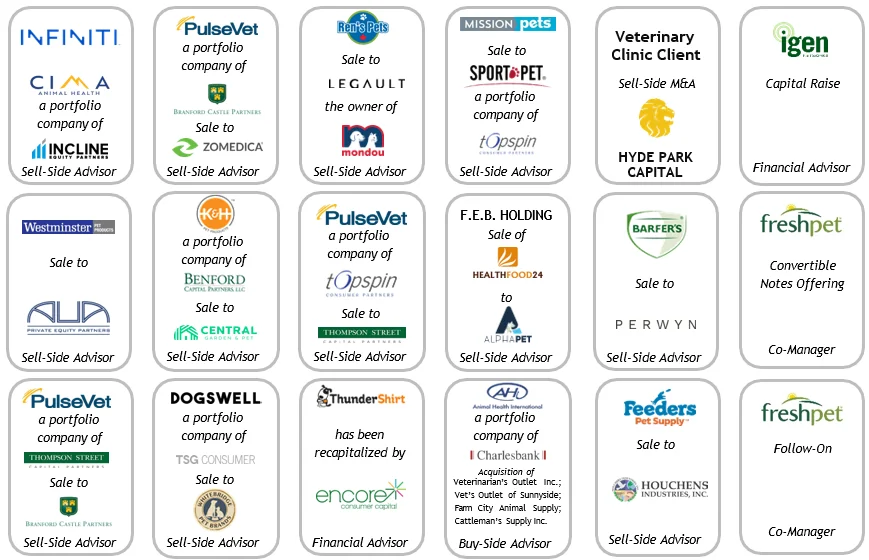
- HPC is one of the most active boutique investment banks in the country managing sell-side M&A engagements in the Services Sector
- Advised on 300+ transactions and has been a consistent leader in providing independent and unbiased strategic counsel and advisory services to global sellers and buyers of middle-market firms
- Diverse team with extensive execution experience across all areas of Services
- Bulge bracket capabilities with a boutique touch
By: Craig Lawson
Managing Director
Craig Lawson, MD, leads HPC’s pet/vet/animal health practice. Mr. Lawson has active relationships with senior level management at the most active strategic acquirers across the globe. He maintains regular contact with financial buyers who have existing investments in pet/vet/animal health companies and or who have a high degree of interest in making new investments in the space.
Experience:
- 25+ years of investment banking experience
- Former founder & managing director of investment bank MHT Partners (acquired by Cowen in 2020)
- Advised on 75+ M&A transactions and numerous capital raises
- Previously also with Harris Williams, BAML, Bear Stearns, and Fidelity Investments
Education:
- B.A. in Economics and History from Tufts University
- M.B.A., (Wharton)
- C.F.A. designation