
By Michael Johnson and Joe Pennington of Hyde Park Capital
Key Takeaways
- Legal services is emerging as a major institutional investment category
- MSOs provide a scalable framework for investor participation while preserving attorney control
- Personal injury has led the first wave, but investor interest is expanding into corporate, compliance, and private-client practices
- Succession planning and ownership transition are becoming increasingly important strategic considerations
- Structure and regulatory compliance remain critical determinants of long-term success
Executive Summary
The legal services sector is rapidly becoming one of the most attractive opportunities within professional services investing. As institutional capital finds new pathways into the industry, legal services is evolving into a meaningful platform-building category, and the firms that understand the legal MSO model early will have a meaningful advantage over those that treat it as a niche or temporary trend. The combination of market size and fragmentation, recurring demand, evolving regulatory frameworks, and significant opportunities to invest in technology, marketing, client acquisition, and operational infrastructure is creating exactly the type of environment that has historically attracted sophisticated capital to other professional-services sectors.
The central insight is simple: investors do not need to own the law firm to build value around it. In the United States, the most scalable path is usually not direct equity in a legal practice but an MSO structure that centralizes marketing, intake, technology, HR, finance, recruiting, and other nonlegal functions while preserving lawyer control over the practice itself.
This is not a future concept. It is already happening. Rafi Law Group launched Rafi Law Services and secured a $125 million strategic investment in April 2026, while Morgan & Morgan, the country’s largest personal injury law firm, has explored a potential minority stake transaction reportedly worth more than $1 billion. At the same time, the market is already expanding beyond consumer legal services, with corporate-focused structures in play and growing sponsor interest in trusts and estates, wealth-adjacent legal services, and other practices that sit at the intersection of law, tax, finance, and long-term client relationships.
From Hyde Park Capital’s perspective, this is one of the most important emerging themes in professional services M&A. The opportunity is substantial, but it is not generic. The winners will be investors and law firm leaders who understand where the model works, how to structure it, and how to build around regulatory reality instead of trying to wish it away.
What Draws Investors In
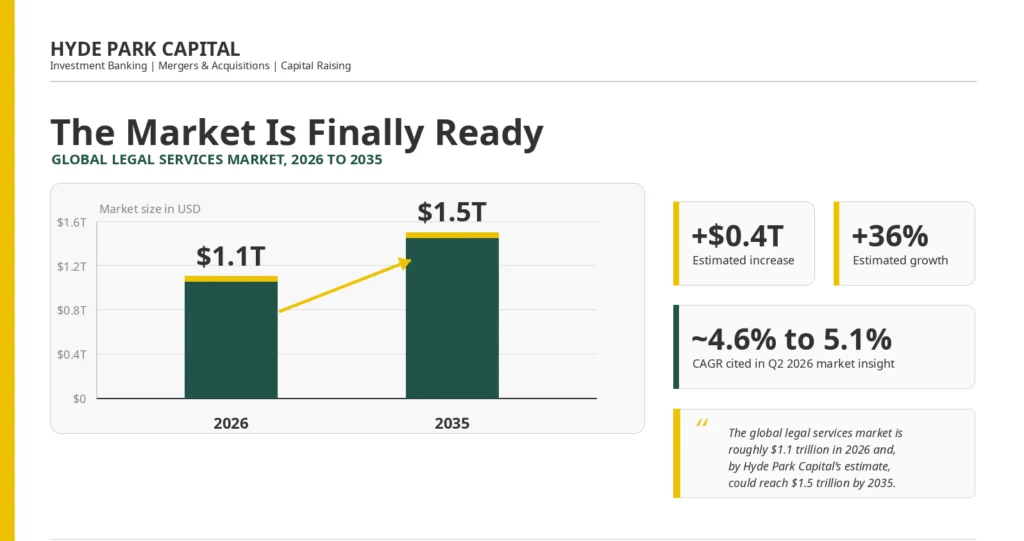
The combination of market size and fragmentation, recurring demand, evolving regulatory frameworks, and significant opportunities to invest in technology, marketing, client acquisition, and operational infrastructure is creating exactly the type of environment that has historically attracted sophisticated capital to other professional-services sectors
What We're Hearing From Law Firm Leaders
- Succession planning is challenging
- Marketing costs continue to rise
- Technology investment requirements are accelerating
- Recruiting and retention remain competitive
- Firms want more flexibility around ownership transition
- AI is creating both opportunity and uncertainty
Why Firms Are Exploring M&A

The Signal Transactions Everyone Should Be Watching
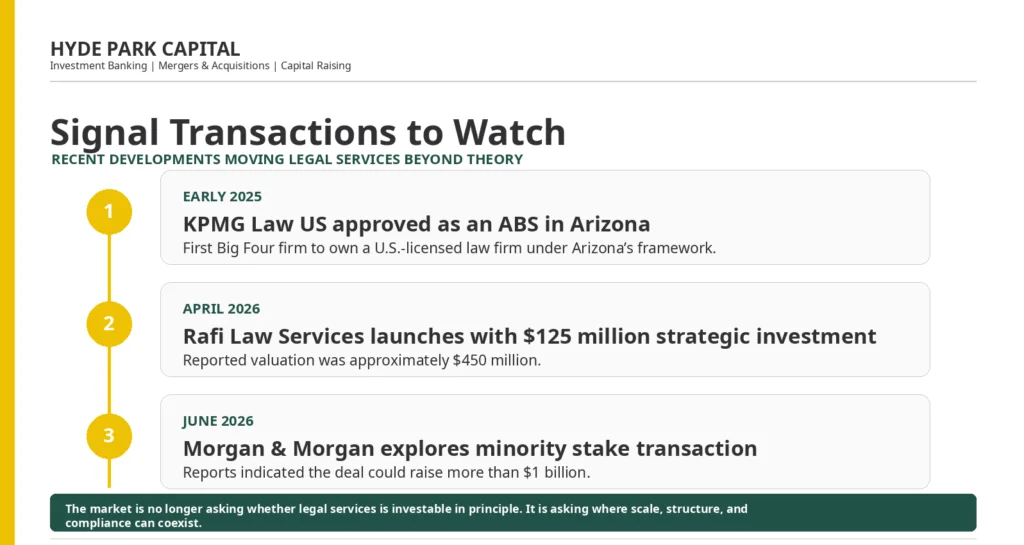
Several recent developments have made clear that this market is moving beyond theory.
Rafi Law Group / Rafi Law Services
In April 2026, Brandon Rafi launched Rafi Law Services, a newly formed MSO, alongside a $125 million strategic investment that reportedly valued the business at approximately $450 million. Law360, Bloomberg Law, and ABC15 each described the transaction as a back-office separation designed to fund technology, infrastructure, growth, and future law firm partnerships through an MSO framework.
Why this deal matters is not just the dollar amount. It shows that a founder-branded personal injury platform with strong marketing density can monetize its nonlegal operating stack at real scale while preserving founder control and minority-investor participation in the MSO.
Morgan & Morgan
In June 2026, Reuters and Axios reported that Morgan & Morgan was exploring a minority stake transaction that could raise more than $1 billion. The firm is reportedly evaluating options to support continued investment in technology, infrastructure, recruiting, and long-term growth initiatives. While John Morgan indicated discussions remained preliminary and any transaction was uncertain, the fact that the country’s largest personal injury law firm is exploring outside capital is itself highly significant.
Morgan & Morgan matters because it changes the conversation. Once the largest player in the category is openly evaluating outside capital, the legal MSO market is no longer a fringe strategy for early adopters. It becomes a boardroom topic for every scaled consumer law platform in the country.
Beyond Consumer Law
The expansion is already broader than plaintiff law alone. Hyde Park Capital’s market update points to Alpine-backed Nova Law Group supporting Rimon through an MSO structure, illustrating that the model can extend into sophisticated business-law settings as well as consumer-facing ones. Separately, public reporting indicates that other corporate-side firms have explored PE-backed MSO or MSO-adjacent structures, even where not every process has resulted in an announced closing.
That matters because it confirms the market is not simply asking whether MSOs work in advertising-heavy consumer categories. The more important question now is which non-consumer legal practices have enough repeatable workflow, operational burden, and client-stickiness to support an institutional operating platform around the lawyers.
Why KPMG Law Matters
KPMG Law is worth watching not because it is an MSO, but because it validates the broader direction of travel in legal services. Arizona approved KPMG Law US as an ABS in early 2025, making KPMG the first Big Four firm to own a U.S.-licensed law firm under Arizona’s framework.
That development matters for two reasons. First, it demonstrates that large multidisciplinary service organizations view legal capabilities as strategically adjacent to tax, compliance, transaction support, and consulting. Second, KPMG’s corporate-focused launch reinforces the point that alternative legal business structures are not confined to consumer practices; they also have relevance in post-merger integration, compliance management, and other business-law environments.
KPMG also sharpens the competitive lens around trusts and estates, private clients, and wealth-transfer work. As commentators have noted, if multidisciplinary firms can combine legal services with tax, advisory, and wealth-management functions, private-client and estate-planning practices become far more interesting as strategic platforms than many investors appreciated a few years ago.
Key Transactions
Drivers Towards Premium Valuations
- Strong brand recognition with measurable demand drivers.
- Centralized intake, workflow, and operating systems rather than purely ad hoc partner execution.
- Repeatable case or matter management with clear performance metrics.
- Sufficient scale to support professional management across finance, HR, marketing, recruiting, compliance, and data.
- A legal and ethical structure that separates business optimization from legal judgment.
Why the MSO Model Is Winning
In most U.S. jurisdictions, nonlawyers still cannot simply buy law firms outright. Arizona has gone furthest through its ABS framework, Utah has used a sandbox approach, D.C. has a more limited version of outside participation, Puerto Rico recently adopted partial nonlawyer ownership rules, and California continues to allow compliant MSO structures while policing fee-sharing boundaries.
That patchwork is exactly why the MSO model matters. It offers a practical route for capital to participate in the economic upside by investing in the operating company around the law firm rather than the legal practice itself.
In a well-structured legal MSO, the firm remains responsible for legal work, ethics, client representation, and professional judgment, while the MSO provides the business engine: brand building, lead generation, call-center infrastructure, CRM systems, HR, accounting, real estate, procurement, vendor management, and data analytics. That is why the legal MSO should not be viewed as a workaround alone. It is increasingly the core operating architecture for institutional capital in legal services.
Why Personal Injury Led the First Wave
Personal injury remains the clearest current proving ground because the business model aligns well with many of the features private equity likes best. Investors identify the segment as fragmented, localized, process-driven, consumer-facing, and supported by recurring demand, high case velocity, and standardized workflows.
That matters because sponsors are not underwriting legal brilliance alone. They are underwriting whether a platform can reliably generate leads, convert inquiries, manage cases efficiently, support lawyers with better systems, and expand into adjacent geographies without losing unit economics.
Personal injury also offers strong brand leverage. In many markets, the firms that win are not necessarily those with the oldest partnerships or deepest corporate relationships; they are the ones that build consumer awareness, respond fast, invest in intake, and manage high volumes without operational slippage.
The Next Opportunities Beyond PI
The next phase of capital deployment is likely to be more selective, but broader. And currently while the highest-fit practices remain high-volume consumer categories, the market is already evaluating how MSO economics may apply to certain corporate, compliance, and advisory settings. Public commentary around corporate-side firms and multidisciplinary legal offerings support the same conclusion: investor interest is moving outward from the first obvious use cases.
Trust and Estate law is a particularly interesting example. It does not have the same lead-generation profile as personal injury, but it does sit close to tax planning, wealth management, trust administration, succession planning, and long-duration client relationships, all of which can support broader platform strategies when paired with the right regulatory structure.
The implication is important. The most attractive legal platforms over the next several years may not all look like consumer-advertising machines. Some may look more like integrated professional-services businesses built around private clients, owner-led companies, transaction support, or compliance-heavy recurring work.
What Sophisticated Investors Actually Underwrite
The best legal MSO deals are not simply bets on revenue growth. They are bets on whether the nonlegal operating platform has enough substance, discipline, and scalability to justify institutional capital.
From an investor’s perspective, the most investable platforms tend to share several characteristics:
- Strong brand recognition with measurable demand drivers.
- Centralized intake, workflow, and operating systems rather than purely ad hoc partner execution.
- Repeatable case or matter management with clear performance metrics.
- Sufficient scale to support professional management across finance, HR, marketing, recruiting, compliance, and data.
- A legal and ethical structure that separates business optimization from legal judgment.
Not every law firm is positioned to benefit equally from an MSO structure. The model tends to be most effective for firms with sufficient scale, repeatable workflows, operational infrastructure, and leadership teams focused on long-term growth.
Structure Matters More Than Hype
The fastest way to misunderstand this market is to assume the legal MSO is a simple transplant from another professional-services sector. The analogy is useful, but legal services has its own fault lines: fee-sharing constraints, attorney independence, client-choice rules, limits on non-competes, and a highly fragmented state-by-state regulatory map.
That is why structure is not a legal footnote. It is the investment thesis. If the management agreement, governance, fee model, employee allocation, or compliance framework is wrong, the transaction can become unfinanceable, unscalable, or worse, noncompliant.
In most jurisdictions, the highest-risk mistake is trying to disguise direct participation in legal fees as a management fee. More durable structures tend to rely on fair-market-value service economics, fixed or cost-plus logic, disciplined governance boundaries, and careful allocation of which functions sit in the firm versus the MSO.
What Comes Next
The legal MSO market is still early, but it has clearly crossed an important threshold. The combination of Rafi’s $125 million transaction, Morgan & Morgan’s exploration of a potential minority capital raise, the continued development of Nova-style business-law structures, and the strategic implications of KPMG Law all demonstrate that institutional capital is no longer asking whether legal services is investable in principle.
The better question is where scale, structure, and compliance can coexist. In the near term, consumer legal services will likely remain active because the operating model is easiest to centralize and the return on business infrastructure is most visible. But that should not obscure the broader reality that the market is already spreading into corporate, compliance, and private-client adjacent categories.
Another sign of maturation is the growing use of more creative risk-allocation tools in deal structuring, including regulatory puts and similar mechanisms designed to address the possibility of adverse bar, court, or legislative action after closing. Their emergence reflects a market that is still evolving in real time and becoming more sophisticated about how regulatory uncertainty is priced, allocated, and managed between sponsors and firms.
The winners in this space will not be the groups that talk most loudly about disruption. They will be the ones that build compliant, data-driven, professionally managed operating platforms around legal demand and pick practice areas where the model genuinely fits.
Conclusion
Legal MSOs are quickly becoming one of the most consequential developments in the business of law. The question is no longer whether institutional capital will participate in legal services. That transition is already underway. The more important question is which firms, investors, and operating platforms will be best positioned to capitalize on the opportunity while preserving the professional standards and client relationships that have long defined the legal profession.
Hyde Park Capital Legal Services Contacts
|
Michael Johnson Managing Director (618) 799-9677 |
Joe Pennington Director pennington@hydeparkcapital.com (414) 704-8922 |