Why Developers Must Secure Generation Now
The rapid expansion of hyperscale data centers is creating one of the most significant shifts in power demand in modern history. Power availability is emerging as a primary constraint on data center development. Driven by AI, cloud computing, machine learning and storage, big data analytics, etc., hyperscale data center demand is accelerating far faster than the power grid can expand.
Our highly regulated grid simply wasn’t built for rapid power expansion. As a result, developers are increasingly confronting a new reality: the ability to secure generation capacity is now a prerequisite for securing tenants for large-scale data center projects. The strategic question is no longer where to build, but also how to power it.
Historic Surge in Power Demand
Electricity consumption in the US is rising at a pace not seen since the industrial expansion of the mid-20th century. Hyperscale operators are investing hundreds of billions of dollars into new infrastructure to support AI workloads, cloud computing capacity, and myriad other activities critical to our 21st century digital economy. Unlike earlier generations of data centers in the 2000’s, AI-focused facilities require dramatically higher power density. GPU clusters used for model training consume multiples of the power required by legacy computer environments.
As a result, new hyperscale “campuses” are being designed at an unprecedented scale. Projects that once required 50–100MWs of power are now routinely planned in phased multi-GWs. Plus, dozens of such projects are moving through development pipelines simultaneously.
Our Grid Cannot Keep Up
The grid was not designed to support such rapid load growth in demand. For several decades, U.S. electricity demand has been relatively flat. Utilities and grid operators consequently slowed generation expansion and transmission investment. Today, that dynamic has reversed.
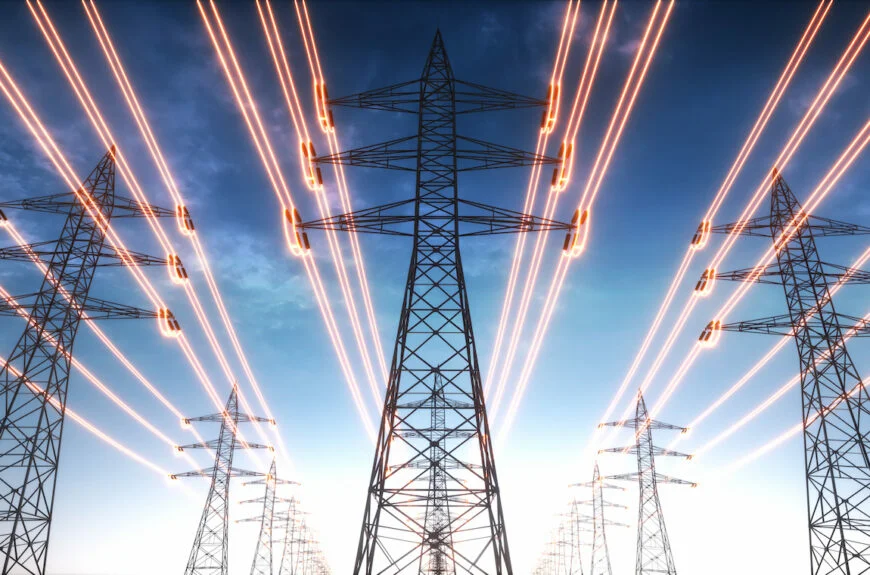
In key data center markets, e.g., Northern Virginia, Texas, Arizona, etc., utilities are facing unprecedented requests for new power connections. Interconnection queues have grown so large that developers are now being quoted four to six years for firm delivery. For developers on tight timelines, these delays are simply incompatible with tenant demand. Consequently, the traditional model, which was securing land first and then power second, has become obsolete.
Shift Toward Onsite Power
Faced with grid constraints, developers are adopting a new model: self-generation with onsite or “inside-the-fence” power. This “bring-your-own-power” approach is becoming increasingly more common in markets where utilities cannot guarantee sufficient capacity within reasonable timelines. For developers, the model offers several advantages:
- Accelerated project timelines by bypassing grid delays
- Dedicated, predictable power supply for hyperscale tenants
- Potential long-term energy cost control
- Improved reliability and redundancy
In practice, this involves developing gas-fired generation assets capable of supporting large continuous, volatile loads, often at multi-GW scale. Power generation is no longer just a utility service; it’s becoming a core component of data center development creating opportunities for power developers.
Equipment Is the New Bottleneck
Power generation equipment is now emerging as one of the most critical constraints facing data center expansion. Large gas turbines and other dispatchable technologies remain the most reliable way to bring significant new generation online. Whereas global manufacturing capacity is largely fixed, demand has surged as utilities, IPPs and data center developers compete for the same equipment.
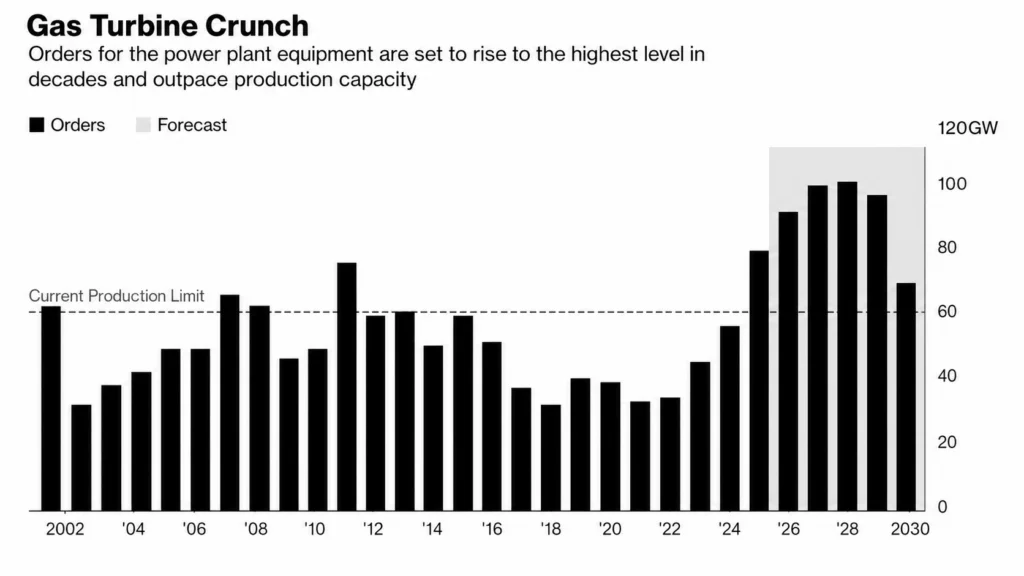
Source: Bloomberg
Major manufacturers such as GE, Siemens and Mitsubishi are reporting record order backlogs. For developers who require hundreds of MWs of firm capacity, waiting several years for new equipment production may not be feasible. This has created an emerging market for available or redeployable generation equipment, including turbines originally manufactured for power plants that were never completed or projects that were cancelled or delayed. In many cases, acquiring existing equipment can shorten development timelines by years.
Strategic Implications
For developers, the implications are clear: access to generation capacity will determine which projects can be delivered. Developers who can secure power early in the development process will have a significant competitive advantage in attracting hyperscale tenants, which is the key to unlocking financing. Several strategies are emerging:
- Securing generation equipment early: Developers are seeking to acquire turbines and other equipment well in advance of final project approvals.
- Partnering with power infrastructure investors: Private infrastructure funds are actively seeking opportunities to finance generation assets tied to data center developments.
- Developing “powered land”: Sites with both land and dedicated generation capacity are becoming highly attractive to hyperscale tenants.
- Repurposing existing power assets: Idle or underutilized generation equipment can significantly reduce development timelines compared with new development.
The Impact of the Iran Conflict
The Iran conflict has not directly restricted the supply of gas turbines to the US, but it has materially tightened availability through second-order effects. Demand for on-site generation—already surging due to AI-driven load growth—has accelerated further as developers prioritize energy security and speed to power. This has intensified competition for both large frame units and aero-derivative turbines with major OEMs operating with elevated order backlogs and increasingly selective allocation of production slots.
At the same time, the conflict has introduced meaningful supply chain and cost pressures. Disruptions to global energy markets and shipping routes—particularly the Strait of Hormuz—have increased input costs, delayed component deliveries, and extended already long manufacturing lead times. While the US benefits from relatively advantaged natural gas pricing, global volatility has led to both project delays and a front-loading of turbine orders by developers seeking to lock in capacity, further tightening near-term availability.
For data center developers, turbine availability is now as much a function of financing strategy and credit profile as physical supply. OEMs are prioritizing counterparties with strong balance sheets and/or fully financed projects. As a result, successful developers are moving earlier—securing equipment through deposits, structured procurement agreements, or leasing solutions—to ensure access to generation capacity in an increasingly constrained and competitive market. This is where Hyde Park can help.
The Role of Hyde Park Capital
Project financing of critical operating assets can involve complex structuring. Hyde Park Capital has extensive resources that can fill any segment of the capital stack. From senior and junior debt, mezzanine funding, project equity and tax equity, we can develop an optimized solution for large-scale power projects.
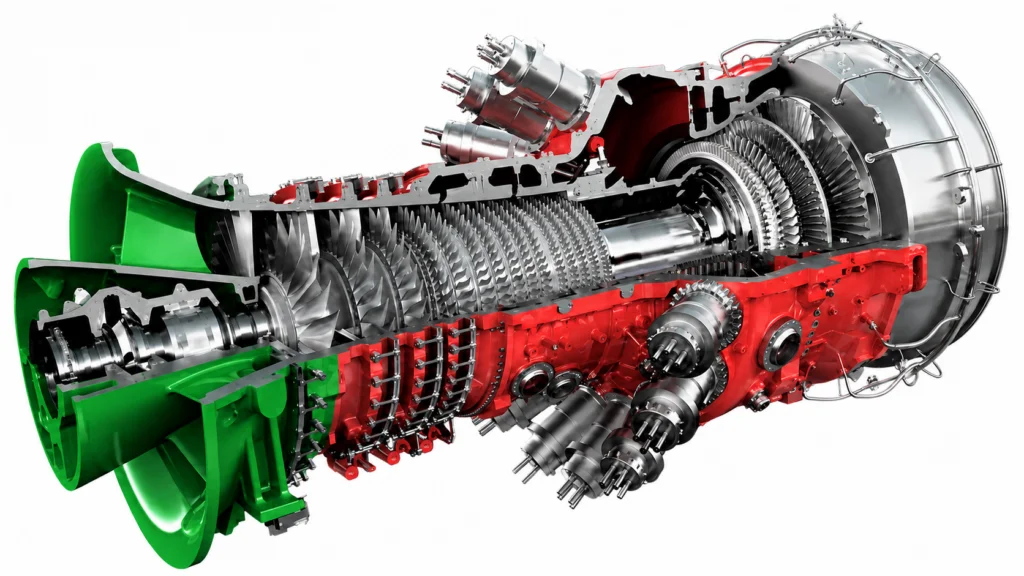
Financing tenors may range from short-term leases to long-term (e.g., 15-20yrs) financing. In addition, we have the ability to identity large blocks of generation equipment for developers. Identified equipment may include gas turbines, reciprocating engines and frame units. Ancillary equipment may include battery storage energy systems, selective catalytic reduction units, etc. At any given time, Hyde Park Capital may have several GWs of identified equipment that may be available. In addition, our financing capabilities extend beyond generation equipment to include compute infrastructure, i.e., servers, GPUs/CPUs, storage, networking gear, racks, and related electronics.
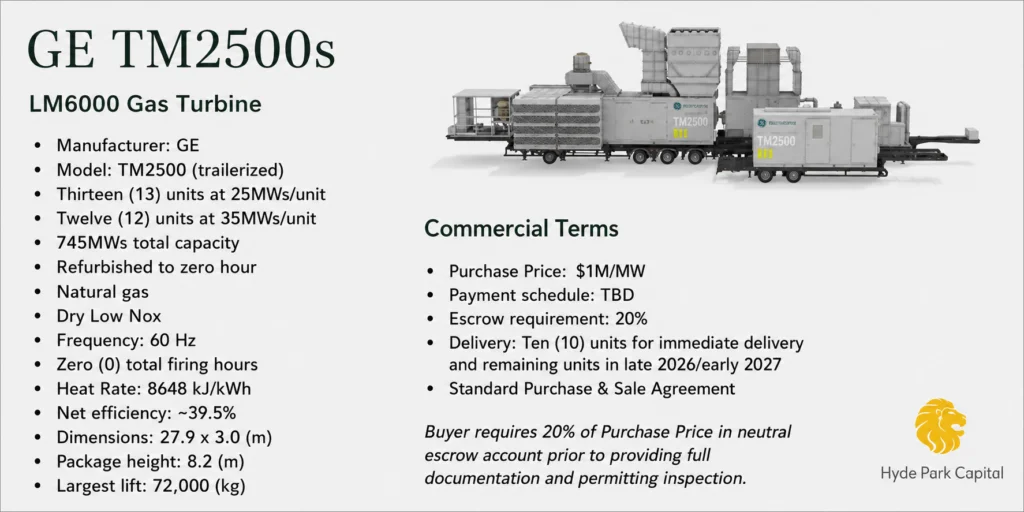
Below is an illustrative example of equipment we have identified as available for sale. Our team is able to access the sellers for the benefit of our clients under an engagement to arrange financing. As stated, we can pair units with BESS, SCRs, etc.